Hierarchical Reasoning Model
Hierarchical Reasoning Model
Paper: https://www.alphaxiv.org/abs/2506.21734
Context
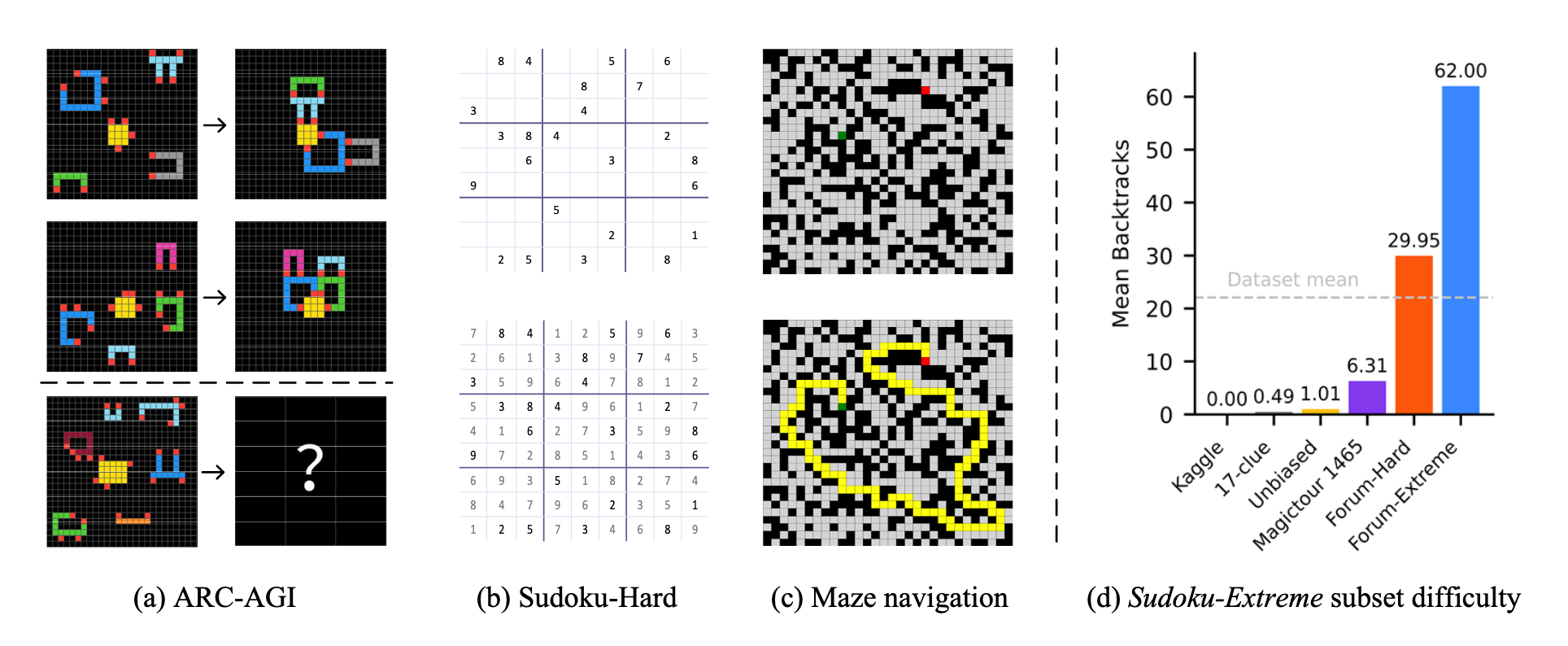
Abstract Reasoning Corpus (ARC)
This paper aims at solving ARC using minimal amount of computation with a new archtecture.
- Lots of research papers refer to this book
- The book talks divides brain’s thinking process into slow and fast
- Fast: Fast, Automatic, Intuitive
- Slow: Deloberate, effortful reasoning
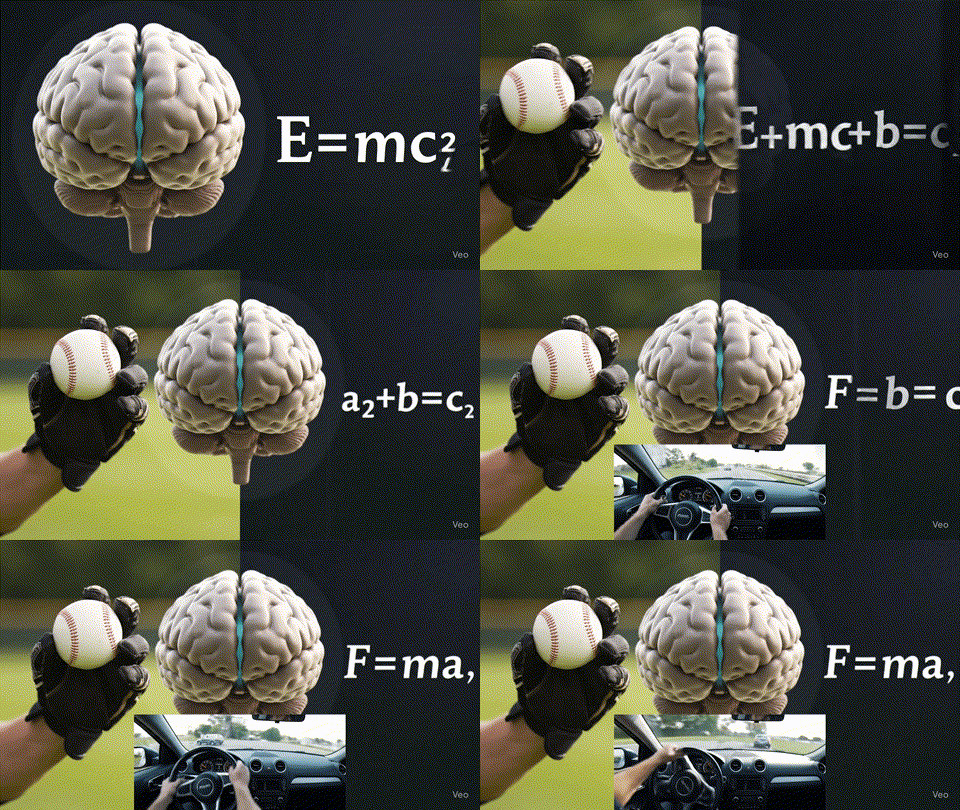
Introduction
Previous reasoning models use CoT (Chain-of-Thought), downsides:
- Brittle task decomposition: Single misstep can break the chain
- Extensive data requirements: Large training data
- High latency: Generates loads of token; slowing down inference
WHat are they offering: Latenet Reasoning
- Language is for human communication and ideas/thoughts are compressed effectively without translating back to language
- The model operates within its own hidden state
Inspired by human brain
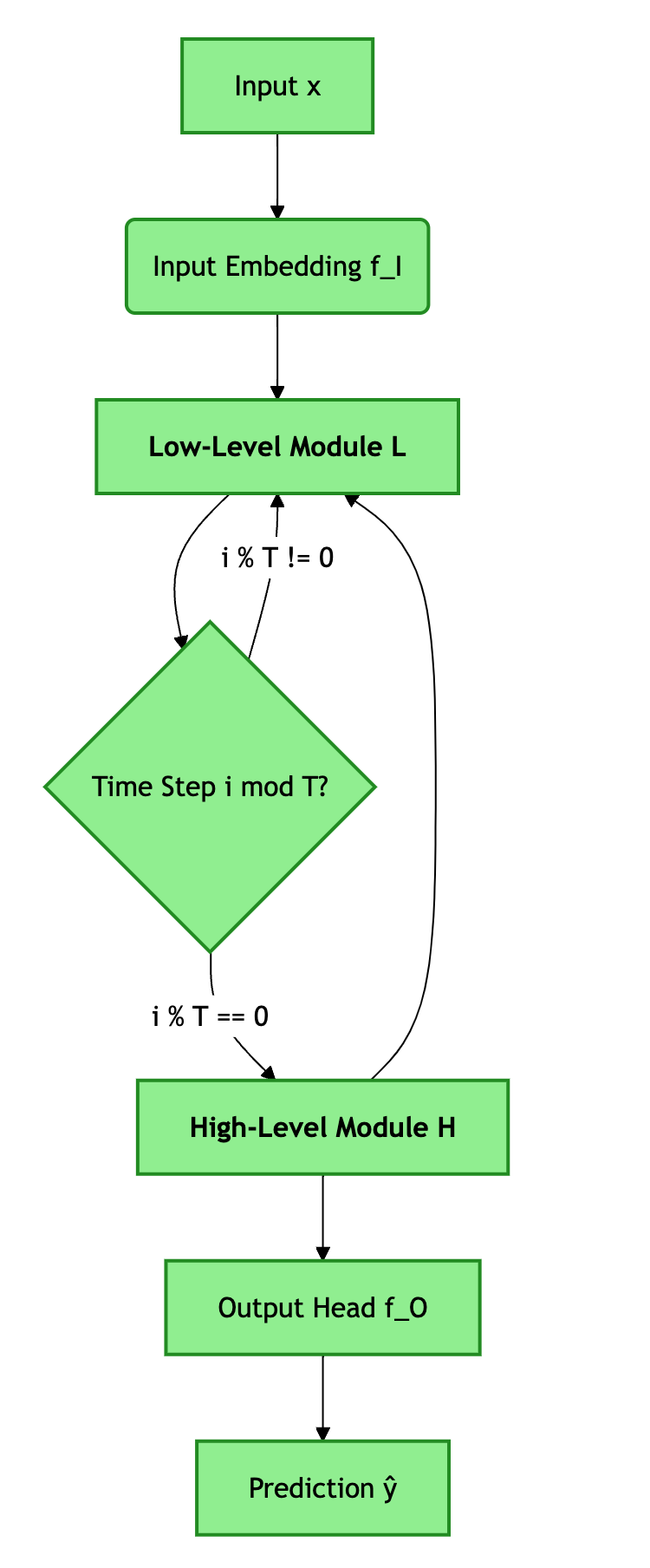
- High-level (slow) part and low-level (fast) part interact
- The low-level exectures ideas based on the global knowdlege stored in High-level
- High-level gets feedback from low-level and adjusts
- Hierarchy and multi-stage
Datasets
Result
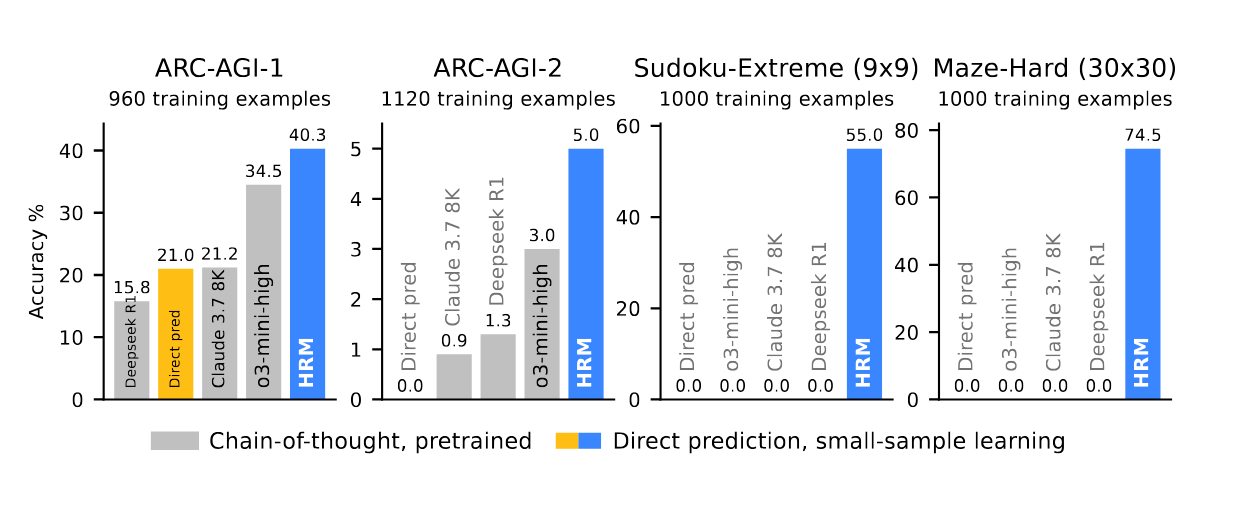
- Models being compared are general purpose
- Not tested on ARC-3
Method
Data + Augmentations
1000 From each (ARC, Sudoku, Maze) + ==≥ 3,831,994
- ARC: transition/rotations/flips/color permutations
- Soduku: used band and digits permuations
- Maze: No change, raw data used
H-L combo
- H-level updates after T steps of L-level
- When L-level reeaches local equilibrium
- H-level’s world-view changes; L-level resets -≥ new computation path
- N (number of H update) x L (number of l updates) increase the reasoning depth
Memory footprint
Backpropagation Through Time (BPTT) saves model parameters at each time step and backpropagates.
- Biological implausibility: Human brain does not do this
This approach is O(1): Constant memory; uses one-step gradient approximation::uses the first and last state of H and L level, intermediary steps as constants.
- Aligns with idea of local rule in brian
- Brain does not utilize all previous computations for learning
More Detailed Result
ARC-AGI Performance Comparison (HRM vs. Baselines)
| Model | Size (Params) | ARC-AGI-1 (%) | ARC-AGI-2 (%) | Pretraining? | CoT Used? | Notes |
|---|---|---|---|---|---|---|
| No Pretraining + No CoT (Trained from scratch, minimal supervision) | ||||||
| HRM | ~27M | 40.3 | 5.0 | ❌ | ❌ | Proposed model; uses hierarchical recurrence, latent reasoning |
| Direct pred (8-layer Transformer) | ~27M | 15.8 | ~0.0 (implied) | ❌ | ❌ | Same size as HRM, but standard architecture fails on hard tasks |
| Liao & Gu (equivariant CNN) | ~10–50M (est.) | 15.8 | Not reported | ❌ | ❌ | Specialized architecture tailored to ARC; hand-designed inductive biases |
| Pretrained + CoT-Based (Large language models using step-by-step prompting) | ||||||
| o3-mini-high (GPT-4o variant) | ~48B | 34.5 | 1.3 | ✅ | ✅ | Top CoT model in evaluation; uses 128k context |
| Claude 3.7 8K | ~100–200B (est.) | 21.2 | 0.9 | ✅ | ✅ | Proprietary model; strong CoT capability |
| Deepseek R1 (est.) | ~100B+ | ~21.0 | ~0.0 | ✅ | ✅ | Estimated performance based on plot in paper |
| Pretrained + CoT (Other Notable Models) | ||||||
| AlphaGeometry 2 | ~100B+ | ~20–25 (est.) | Not tested | ✅ | ✅ | Specialized for geometric puzzles, not full ARC-AGI |
| GPT-4o (Base) | ~48B | ~30–35 (varies) | N/A | ✅ | ✅ | Public results vary; performance depends on prompt engineering |
🔍 Key Insights:
- HRM is in a different league: Despite using no pretraining, no CoT, and 1,000× fewer parameters, it outperforms all CoT-based models on ARC-AGI-1.
- Efficiency: HRM achieves 40.3% on ARC-AGI-1 using only 960 training examples and 27M parameters — a level of data and parameter efficiency unmatched by any other model.
- CoT limitations: Even the strongest CoT models struggle with ARC-AGI-2, which requires compositional, multi-step abstraction — suggesting CoT has fundamental limits on novel reasoning.
- Architecture > Scale: HRM proves that better internal reasoning design can beat scaling alone — a shift from “bigger is better” to “deeper, structured computation wins.”
This hierarchical view underscores HRM’s significance: it achieves superior reasoning not by being larger or more data-hungry, but by thinking differently — deeply, internally, and adaptively.
Related
Resembles these: