Deep Researcher with Test-Time Diffusion
These are notes for this paper.
Similarity to Hierarchical Reasoning?
Similar to HRM, this approach involves a low-level and high-level a operatives where the high-level drafts out the overall strtucture and planning, and multiple low-level modules evolve the answers then those answers are utilized to refine the original draft/plan. And this continues multiple times.
Ppaer Notes
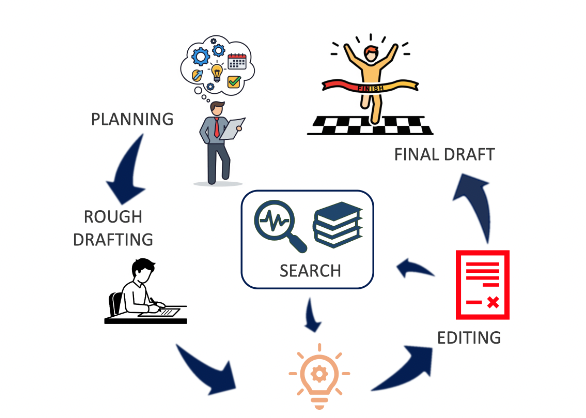
Inspiration from human research: cycles of searching, reasoning, and revision. Humans do not write one word at a time sequentially; there is a process of planning out, writing each part then doing revisions.
Previous works focuses test-time scaling
- CoT
- Best-of-n sampling
- Monte Carlo Tree Search
- Debate mechanism
- Self-refinement loops
The approaches are not cohesive when it comes to drafting, searching and refining
A: Denoising with retrieval
- Initial research report drafted by LLM
- De-noised using external information
B: Self-Evolution
- Each individual component also goes through its own optimization process
- Encourage the exploration of diverse knowledge
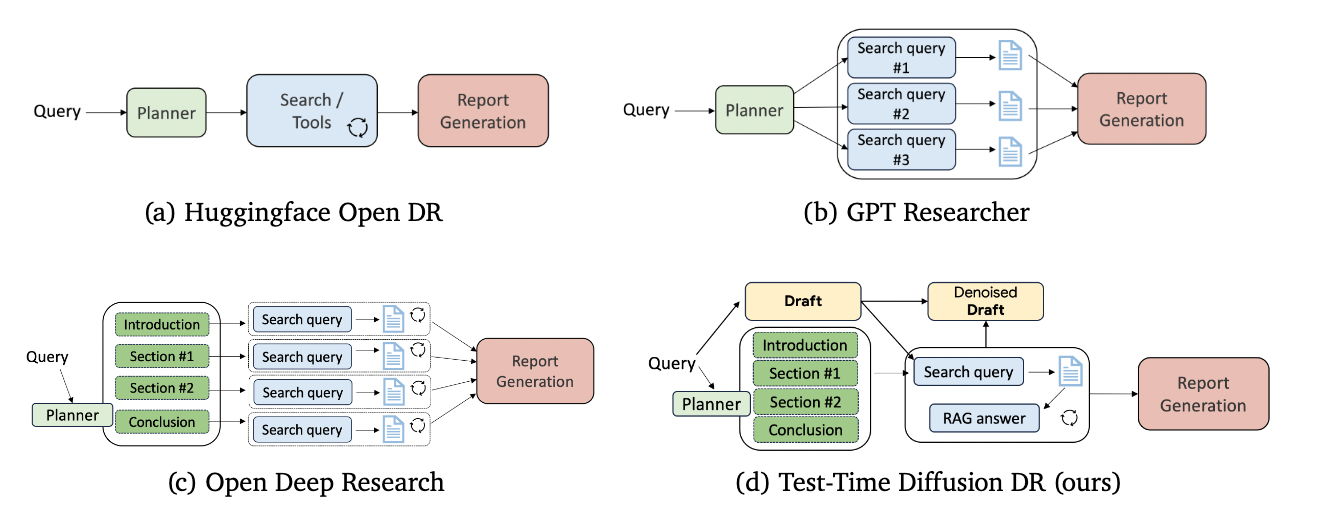
Previous approaches (HuggingFace OpenDR, GPT Researcher, Open Deep Researcher) employ a linear or parallelized process of planning/search/generation -> loss of global context and miss critical dependencies during the research process.
Draft Diffusion
Draft-centric approach remains cohesive, provides a dynamic guide for the research direction; mitigating information loss.
- Stage 1
- Dedicated LLM generates a structured plan
- Outlining key areas
- Initial scaffolding
- Guide subsequent information-gathering process.
- Passes each action to agent steps
- Stage 2
- Answer and Question sub-agents
- One generates question related to the topic the other one answers it
- Stage 3: synthesis

Componet-wise evolution
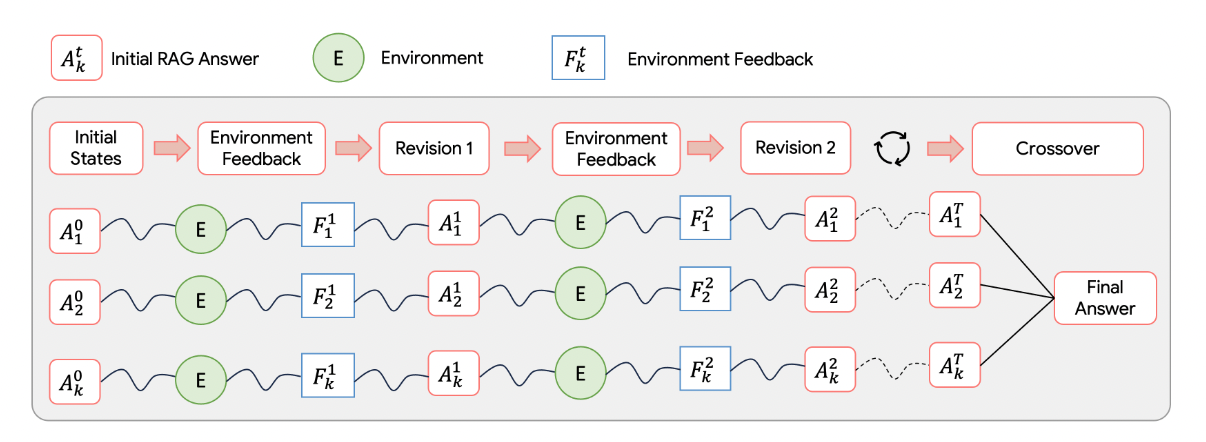
- Produce multiple responses to one search query
- Each asnwers is assesed in an LLM-as-judge for feedback
- With the feedback each answer adjusts
- Merged multiple answers into one
Evalution
This is a multi-step and agent environemnt and it is not straightforward to evaluate. Here is the collected metrics:
- high-quality human judgement annotations
- calibrate LLM-as-judge calibrated with humna preference
- calibrated LLM-as-judge as the final evaluator
Metrics
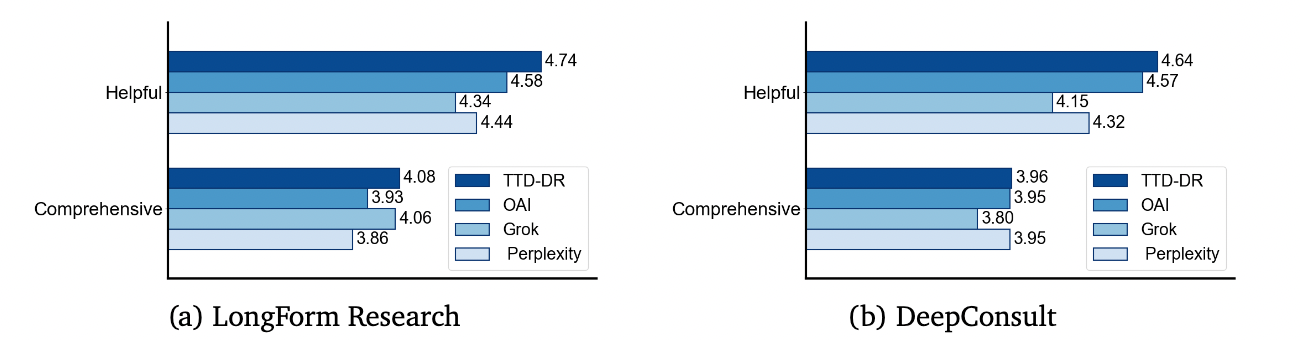
Helpfullness and Comprehensiveness
- Helpfullness
- Satisfying use intent
- ease of understanding
- accuracy
- appropiate language
- Comprehensiveness: Absence of missing key information
Side-by-side quality comparison
AKA pair-wise evaluation with these options between A and B: 1) Much Better If A is both more helpful and more comprehensive than B 2) Better If A is more helpful than B and equally comprehensive as B, or if A is more comprehensive than B and equally helpful as B 3) Slightly Better If A is more helpful but less comprehensive than B 4) About The Same If none of the above conditions are met. The same logic applies when B is better than A.
LLM-as-Judge
two benchmarks used: LongForm Research and DeepConsult
Previous approaches did not use human raters to calibrate the LLM-as-judge
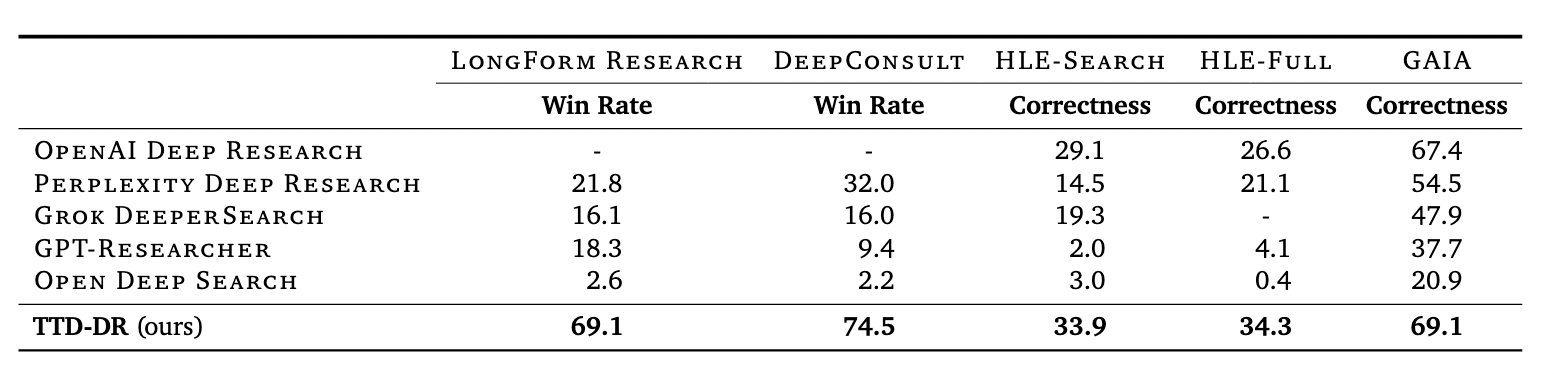
Ablation Studies
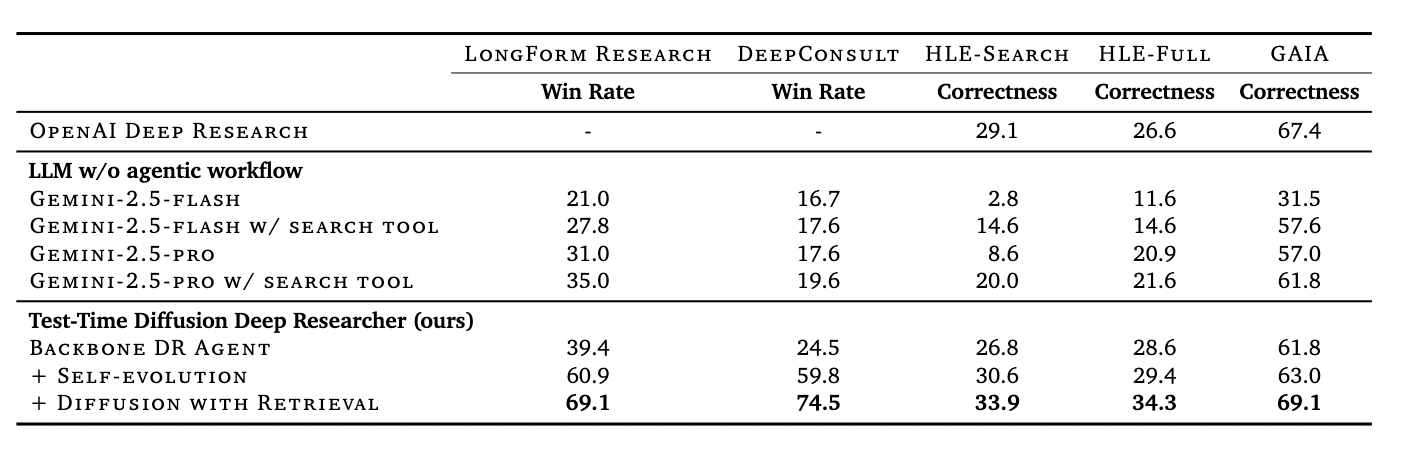
Advanced LLMs perform poorly without search tools
- Gemini2.5-pro on full HLE: 20%, on HLE-search: 8%
- Looking at table below, it is evident that all the loss of the model (from 20% to 8%) was due to lack of search
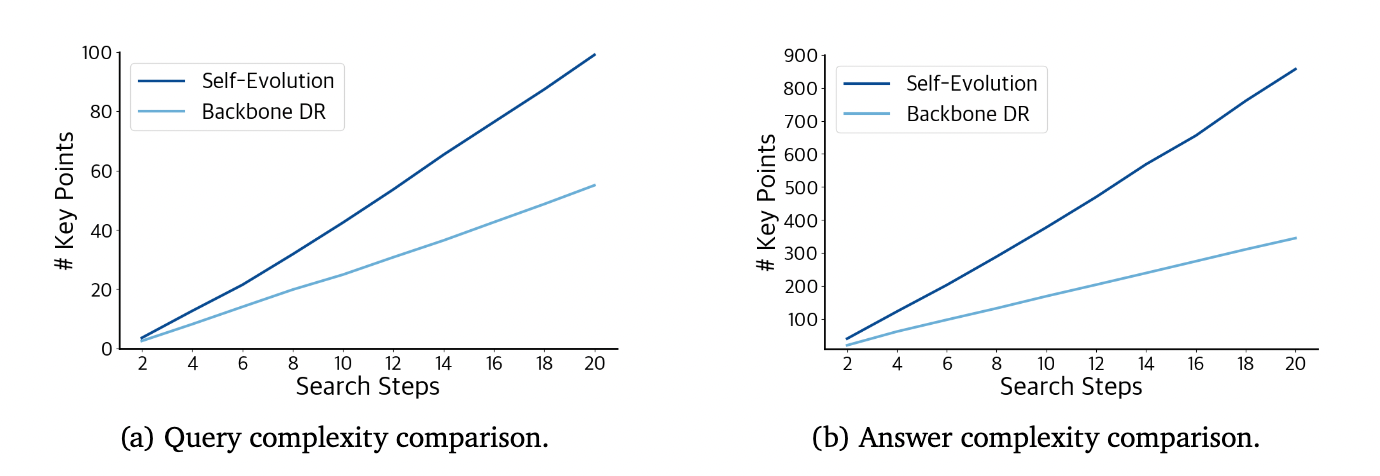
Self-evolution working better
Graph below shows how self-evolution picks up more key points cumulatively as each search step goes on.
Conclusion
- Report generation as a diffusion process
- Preliminary draft is the research direction
- Demonstrates superior performance for long report generation